
Voivod: Symphonique (2026, Century Media Records)
After more than forty years of sounding as though they were transmitting from another dimension, Voivod finally find the perfect accomplice for their strange universe: a symphony orchestra. Symphonique does not tame their angular riffs or avant-garde spirit, but expands them into a cinematic journey through nuclear wastelands, distant planets and impossible dimensions.
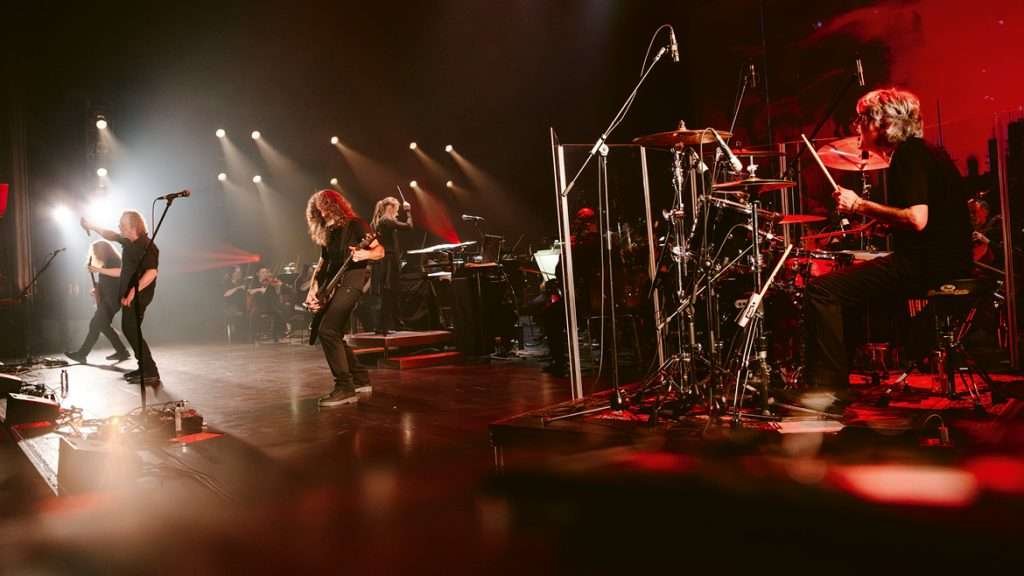
There are few bands in the history of heavy metal that have sounded as if they were trying to escape the boundaries of the genre from the very beginning as Voivod. While many of their contemporaries spent the eighties refining the language of thrash metal, the Canadians seemed determined to dismantle it, rebuild it with completely different pieces and then send the result somewhere into deep space. Their music has always been angular, dissonant, unpredictable and strangely cinematic, qualities that made them pioneers long before words such as progressive, avant-garde or experimental became routinely attached to their name. After more than forty years of existence, however, there are not many places left for Voivod to go where they have not already been, so the announcement of Symphonique, a live album performed alongside the Orchestre Symphonique de Québec, was one of those occasions where it was difficult to know whether we were looking at another logical step in their career or an experiment that would simply look better on paper than it sounded on record.
The answer, fortunately, is considerably more interesting. Symphonique was recorded on June 4, 2025 at the Grand Théâtre de Québec, with the Orchestre Symphonique de Québec conducted by Dina Gilbert, and brings together twelve songs covering several decades of the band’s career. The album was released in June 2026 through Century Media Records and runs for more than seventy-three minutes, although describing it simply as a live album would perhaps be selling the whole idea rather short. Michel «Away» Langevin himself has described the project as a long-standing dream and compared the result to a dystopian science-fiction movie soundtrack, and that description actually captures what makes this record so fascinating. The orchestra is not being used to make Voivod sound grander for the sake of grandeur; instead, the arrangements seem to recognise that there has always been something cinematic hiding beneath those strange guitar lines and apparently chaotic structures.
The first thing that becomes apparent when Experiment opens the album is that this is not one of those collaborations in which an orchestra simply appears behind the band to add some strings to the choruses. The arrangement establishes its own atmosphere before Daniel «Chewy» Mongrain and Denis «Snake» Bélanger gradually take us into the unmistakable world of Voivod, with the orchestra accentuating the tension and dissonance rather than smoothing them out. That distinction is essential because the temptation with this sort of project is usually to make heavy metal sound more «epic» by giving it a layer of classical instrumentation, but Voivod have never needed help sounding enormous. What they needed was an orchestra capable of understanding their strange musical language, and Symphonique works precisely because the arrangements seem to speak that language rather than translating it into something more conventional.
The choice of repertoire also plays an important role in making the experiment work. There is a considerable presence of the band’s most progressive period, with material from Dimension Hatröss and Nothingface occupying a substantial part of the set, but the selection is not restricted to the era most likely to appeal to long-time devotees. Holographic Thinking from Synchro Anarchy sits comfortably alongside The Unknown Knows, Into My Hypercube and Tribal Convictions, while The End of Dormancy and Forgotten in Space demonstrate how naturally the band’s more recent compositions can accommodate orchestral arrangements. Rather than trying to represent the band’s entire catalogue with one song from every album, the setlist seems to have been chosen around compositions that possess enough atmosphere, texture and melodic space to interact with a symphonic ensemble.
That is particularly evident when the album moves into The Unknown Knows, because this is where the orchestra begins to feel less like an accompanying force and more like another member of the band. The strings and brass do not simply reinforce the main riffs; they create tension around them, filling the empty spaces and making the strange harmonic structures of Piggy‘s original compositions sound even more alien. It is almost as though the orchestra has been dropped into the same dimension as the band and, rather than attempting to bring them back to Earth, has decided to follow them into the unknown. This is probably the biggest compliment that can be paid to the arrangements because Voivod‘s music has never been particularly easy to domesticate, and Symphonique never gives the impression that anybody has tried.
There is also a curious relationship between the mechanical and organic qualities of the two ensembles. Voivod have always possessed a strangely industrial character despite being rooted in guitars, bass and drums, with Away‘s drumming and Piggy‘s angular riffs creating the sensation of machinery operating according to rules that only they understand. An orchestra should theoretically make that machinery warmer and more human, yet the opposite often happens here. The strings can sound cold and unsettling, the brass becomes almost threatening and the orchestral swells provide a sense of scale that makes the band sound even more alien. In that respect, Symphonique does not transform Voivod into a symphonic metal band; it makes the orchestra sound like it has entered the Voivod universe.
The most obvious precedent is, of course, the long history of metal bands working with orchestras, from Metallica’s S&M to the many projects that followed once the combination became an established part of the genre. But comparing Symphonique to those records misses the most interesting aspect of this particular collaboration. Voivod were already composing music with a remarkably cinematic quality decades before symphonic metal became a commercially recognisable style, and their science-fiction imagery has always provided a conceptual framework that makes orchestration feel natural. When the strings introduce The End of Dormancy, for instance, the music seems to expand into something closer to a film score before the band enters and reclaims the composition. The effect is not «Voivod with an orchestra» so much as Voivod finally being given the size of the screen on which their music has always seemed to exist.
The same idea reaches one of its strongest points with Forgotten in Space, originally released on Killing Technology. Dominic «Rocky» Laroche has explained that the song already carried a science-fiction atmosphere and that Piggy drew inspiration from the imagery surrounding it when composing parts of the original version. The new orchestral arrangement takes that quality and pushes it considerably further, beginning with a powerful symphonic introduction before the band enters and gradually transforming the composition into something that feels almost like the soundtrack to a journey through a ruined planet. It is one of the clearest examples of the orchestra adding something genuinely new rather than simply decorating what was already there, and it is also one of the tracks that best illustrates why this project makes sense in the first place.
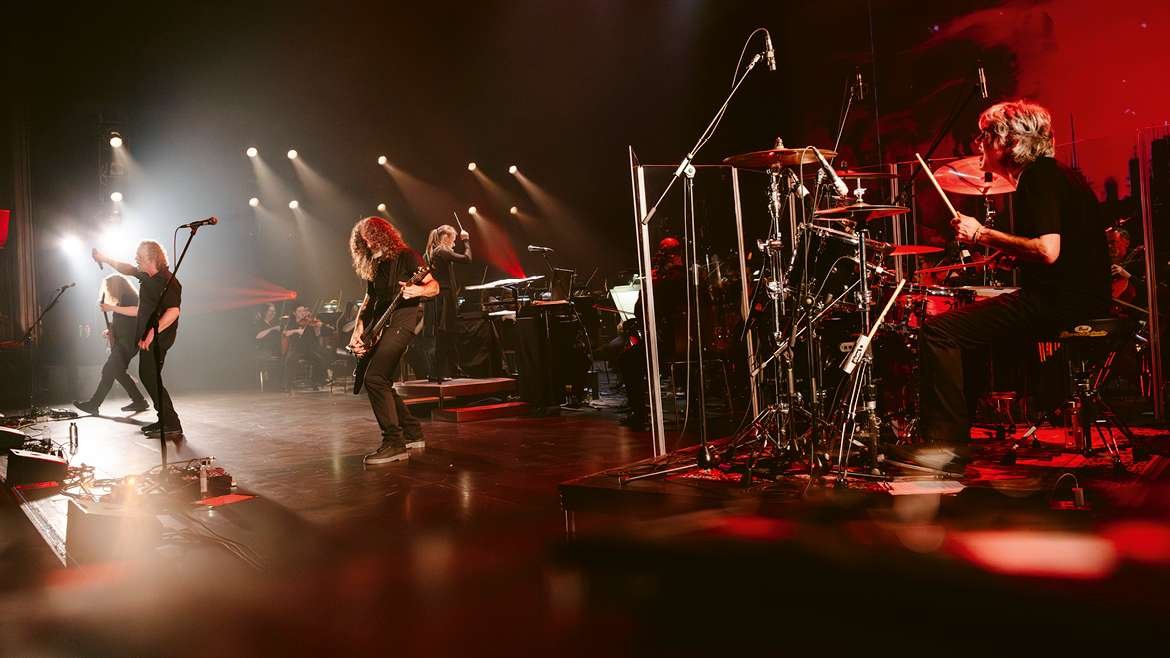
The contrast between Forgotten in Space and Cosmic Drama is equally revealing because Voivod never needed a conventional definition of what a «metal song» should be. Their compositions can move from frantic thrash passages to melodic fragments and strange atmospheric sections without warning, and the orchestra gives those changes a greater sense of consequence. What might previously have sounded like another abrupt turn now feels more like a scene change. This is probably where the cinematic nature of Symphonique becomes most apparent, because the album does not necessarily make the individual songs more complex; it gives their existing changes of mood a different context, allowing the listener to hear them almost as different scenes within the same strange narrative.
There are moments, however, when the experiment becomes considerably more aggressive. Pre-Ignition and Nuclear War retain much of the violence of the band’s traditional approach, although the orchestra adds a sense of impending catastrophe that would be difficult to achieve with the four-piece alone. The latter is particularly effective because the title already gives the listener an idea of where the music is heading, yet the orchestration makes the destruction feel larger and more inevitable. Instead of simply increasing the volume of the guitars, the arrangement creates an environment around them, and this distinction is what keeps Symphonique away from the usual pitfalls of orchestral metal.
It is also worth remembering that Voivod have always been an unusually visual band. Away‘s artwork has been inseparable from their identity since the beginning, and the band’s albums have repeatedly constructed their own strange universe of mutants, machines, planets, nuclear disasters and impossible landscapes. It is therefore hardly surprising that the music should respond so naturally to a full symphonic treatment. The artwork may have provided the visual component for decades, but the orchestra adds something akin to movement, as if those drawings had suddenly become part of an animated film. This is particularly noticeable in the transitions between the different sections of the album, where the orchestra occasionally appears to anticipate the riffs rather than merely follow them, creating the sensation that the narrative exists independently of the band.
The return to Dimension Hatröss material is therefore particularly rewarding. Experiment and Into My Hypercube are among the pieces that demonstrate just how far ahead of their time Voivod were when those songs were written, and the orchestral arrangements do not make them sound old-fashioned. Quite the opposite: the additional instrumentation emphasises the futuristic character that was already there. Into My Hypercube becomes particularly spacious and atmospheric, with the orchestra filling the composition without eliminating the uncomfortable angles that made the original so distinctive. There is something almost amusing about hearing music written in the late eighties suddenly sound even more futuristic in 2026.
That same phenomenon occurs with Tribal Convictions, perhaps one of the most immediately recognisable compositions in the set. The main riff remains unmistakably Voivod, but the orchestral arrangement gives the song an almost ceremonial quality, as though the strange rituals suggested by its title were taking place on a much larger scale. It is one of those moments when the orchestra could easily have overwhelmed the band, yet the opposite happens: the guitars become more striking precisely because there is so much happening around them. The result is grandiose without becoming bombastic, which is a difficult balance to achieve when combining an avant-garde metal band with a full symphony orchestra.
The closing Astronomy Domine is perhaps the most obvious nod to the cinematic and psychedelic side of the project. Originally written by Pink Floyd and appearing on The Piper at the Gates of Dawn, the song has always possessed a dreamlike quality that makes it a surprisingly natural choice for Voivod. Their interpretation does not attempt to disguise its origins, but the orchestral treatment gives the composition a considerably larger sense of space. It also provides an appropriate ending because, after more than seventy minutes of mutants, nuclear destruction, strange planets and distorted dimensions, finishing the journey with a song about looking towards the stars feels almost inevitable.
What makes Symphonique particularly successful, then, is not the novelty of hearing a metal band accompanied by an orchestra. That novelty disappeared decades ago. What matters is that Voivod have found an orchestra capable of amplifying the characteristics that already made them unique instead of replacing them with something more accessible. The arrangements by Hugo Bégin give the songs additional depth and atmosphere, but they never remove the uncomfortable dissonances, crooked rhythms or strangely beautiful melodies that define the band’s music. The orchestra does not correct Voivod; it seems to understand them.
There is also a certain irony in the fact that a band that has spent more than forty years refusing to follow the obvious path has ended up producing one of the most convincing examples of metal and classical music working together. Voivod never needed to become symphonic, and Symphonique does not suggest that they should now abandon their traditional approach. Instead, the album feels like the logical conclusion of an idea that has been present in their music since the beginning: that heavy metal can be something other than a collection of riffs and choruses, that atmosphere can be as important as aggression and that music can create an entire world without needing to explain precisely where that world is located.
For long-time followers, the appeal is obvious, particularly if your favourite period of the band includes Dimension Hatröss, Nothingface and Killing Technology. There is enough familiar material here to make the record feel connected to the band’s history, but the orchestral arrangements give those compositions a different identity rather than simply reproducing them with additional instrumentation. At the same time, listeners who have never found Voivod particularly easy to approach may discover that the symphonic dimension makes some of these songs surprisingly accessible, because the orchestra provides melodic and atmospheric points of reference without taking away the band’s eccentricity. Several reviews have made precisely this observation, noting that the arrangements can make some of the band’s more complex material feel more immediate without sacrificing its character.
Ultimately, Symphonique feels less like an experiment and more like an encounter that was simply waiting to happen. Voivod have spent decades building a musical universe that has always felt larger than the traditional boundaries of heavy metal, while orchestral music has an almost unlimited capacity for turning musical ideas into landscapes. Putting the two together does not suddenly make Voivod grander, more sophisticated or more legitimate than they were before; it simply gives their music another dimension in which to exist. The result is strange, dramatic, occasionally unsettling and often beautiful, which is more or less everything one could reasonably hope for from a band like this.
Perhaps Away was right when he described Symphonique as the closest Voivod have ever come to sounding like a dystopian science-fiction movie soundtrack. After four decades spent travelling through imaginary planets, nuclear wastelands and dimensions that probably should never have been opened in the first place, the strange thing would actually have been if they had not eventually ended up here. The orchestra does not make Voivod sound like somebody else. It simply makes the universe they have been creating since 1982 feel considerably bigger.