
Loudness: A Japanese metal odyssey – Part I: From «The Birthday Eve» to «Jealousy»
From Osaka to Madison Square Garden, Loudness spent the first half of the eighties turning heavy metal into a language without borders. From the raw power of The Birthday Eve and Disillusion to the international success of Thunder in the East and Hurricane Eyes, we look back at the years in which Akira Takasaki, Minoru Niihara, Munetaka Higuchi and Masayoshi Yamashita transformed a Japanese heavy metal band into a genuine international force — before the arrival of Mike Vescera changed everything.

There are bands that are born with the intention of changing the rules of the game, and others that simply appear at the right moment and end up changing them without ever having planned to do so. Loudness belong, in a way, to both categories, although Akira Takasaki, Munetaka Higuchi, Masayoshi Yamashita and, of course, Minoru Niihara could hardly have imagined in 1981 how far that adventure which began in Osaka was going to take them. We are talking about a band that, in barely six years, went from releasing an album sung entirely in Japanese for the domestic market to signing with an American major label, recording in Los Angeles, reaching the Billboard 200 and becoming the first Japanese heavy metal band to make a real impact in the West. It sounds easy when you put it like that, but it is worth stopping for a moment to think about it: while much of the metal world was still looking towards Birmingham, London, Los Angeles or Hamburg, four Japanese musicians were preparing their own assault on a territory that, until then, seemed to belong to everyone else. And the most curious thing of all is that when Loudness finally achieved what they had probably dreamed of from the very beginning, the price they had to pay was starting to move away from precisely the things that had made them such a special band.
It would not be fair, however, to begin this story with Thunder in the East, Crazy Nights or those videos that would eventually find their way onto MTV. It would be like starting an adventure film when the protagonist has already arrived at the place he wanted to reach and forgetting everything he had to go through to get there. And if there is one thing the history of Loudness has, it is precisely that journey, because their first four albums are the photograph of a band progressively discovering what their place within heavy metal could be, while around them the genre was undergoing a gigantic transformation. Judas Priest, Iron Maiden, Scorpions, Rainbow, Accept, Motörhead, Van Halen and so many others had turned heavy metal into something that could no longer be considered a simple offshoot of hard rock, while in the United States a new generation was beginning to emerge that would soon fill stadiums and become part of one of the greatest commercial explosions in the history of the genre. Japan was watching all of this from the other side of the world and, at the same time, developing its own scene. In the middle of that storm came Loudness, four musicians who were not content simply to admire what was happening abroad and decided to find out what would happen if they entered the game themselves.
The Birthday Eve
To understand the birth of Loudness, we have to go back a few years and stop at Lazy, the band in which Akira Takasaki and Munetaka Higuchi had crossed paths during the seventies. Both had already demonstrated extraordinary musical abilities, but the direction that band had taken did not quite satisfy the ambitions of musicians who had something much heavier in mind. British hard rock, the birth of heavy metal and the revolution being led by guitarists such as Ritchie Blackmore, Michael Schenker and Uli Jon Roth had opened up a whole new world of possibilities, and Takasaki was determined to explore that territory. In 1981, Masayoshi Yamashita and Minoru Niihara joined them, completing a lineup that would eventually become one of the most important in the history of Japanese metal. The band themselves mark that moment as the birth of Loudness, with the release of The Birthday Eve and that first concert at the Asakusa International Theater, which brought together around 2,700 spectators.
Listening to The Birthday Eve today feels somewhat like looking at an archaeological document, although using that word may be unfair because the album still retains an energy that can be surprisingly effective. Obviously, this is not yet the Loudness that would eventually conquer America, but it is a band that had understood perfectly what was happening with heavy metal and, above all, had understood that they did not need to copy anyone literally in order to become part of it. The influences are obvious, of course, but the goal was not to hide them. What we find here is Takasaki trying to push the guitar a little further, Higuchi turning the drums into an absolute steamroller and Yamashita providing the foundation needed to keep those songs from collapsing under the weight of the guitars. And over all of this comes Niihara, still a long way from the international vocalist we would meet later, but already bringing that personality that would eventually become one of the band’s trademarks.
There is something particularly interesting about the fact that the first three Loudness albums were sung in Japanese. We are used to thinking of music as a kind of universal language, but for decades the Western record industry operated in a much more closed way, and the chances of an Asian band reaching Europe or the United States singing in its own language were fairly limited. Loudness were not thinking about that yet. They were a Japanese band making heavy metal for a Japanese audience, and perhaps that is where part of the charm of those early works lies. There was no need to adapt anything, soften anything or explain who they were. They were simply playing.
And they were playing with considerable ambition. The Birthday Eve is still an album of youth, discovery and enthusiasm, but in its grooves we can already find some of the characteristics that would grow with them: Takasaki‘s obsession with the guitar, Higuchi‘s ability to make any rhythm sound enormous and that mixture of melody and aggression that would eventually become so recognisable. Let’s not fool ourselves, friends, there was still a long road ahead, but it is fascinating to realise that the direction of that road was already clearly marked.
Devil Soldier
The second chapter arrived barely a year later with Devil Soldier, and here we begin to notice something that would remain a constant throughout this first period: Loudness were moving at considerable speed. While other bands needed several years to find an identity, the Japanese musicians seemed to be learning as they went. It is not that Devil Soldier is radically different from its predecessor, but it certainly conveys much greater confidence and a clearer understanding of what they wanted to achieve. The sound remains essentially classic heavy metal, but the compositions begin to have more personality and Takasaki increasingly becomes the element that can make Loudness stand out above an increasingly crowded scene.
The context could hardly have been more interesting. It is 1982 and heavy metal is in full expansion. Iron Maiden had just released The Number of the Beast, Judas Priest had demonstrated that a metal band could become a worldwide institution and Scorpions were laying the foundations for becoming one of the biggest international names in hard rock. On the other side of the Atlantic, Van Halen had shown that the guitar could once again become a true protagonist, and a new generation of musicians was taking instrumental virtuosity into increasingly ambitious territory. In Japan, meanwhile, Loudness were absorbing all those influences and transforming them into something of their own.
Perhaps that is why Devil Soldier becomes so interesting when viewed from a distance. It is not simply «a Japanese album that sounds like Western bands of the period», but another piece in that enormous cultural exchange that eventually turned heavy metal into a truly international phenomenon. What had begun in Birmingham or London no longer belonged exclusively to Britain, just as rock and roll had ceased to belong to the United States decades earlier. The Japanese had listened to those records, studied them and were now returning their own interpretation, Takasaki had it clear: he had no intention of remaining a student.
The Law of Devil’s Land
With The Law of Devil’s Land, released in 1983, the leap becomes even more obvious. Loudness no longer sound like a band taking a chance, but like a band that knows perfectly well that they have something to offer. The album retains the aggression of the first two releases, but the compositions show increasing maturity and the interaction between Takasaki, Higuchi and Yamashita becomes more impressive with every listen. Niihara, for his part, continues developing the voice that would eventually become immediately associated with the band and which, although still tied to the Japanese language at this point, already possessed enough personality to distinguish them.
And this is where something fundamental happens: Loudness leave Japan. During 1983 they embarked on their first tour of the West Coast of the United States and later travelled to Europe. According to the band’s official history, those performances were precisely what caught the attention of Atlantic Records executives and eventually led to the international contract that would completely change their career.
Let’s think about that for a moment. Four musicians from Osaka had gone from studying the records of the great Western bands to travelling to the other side of the world to share stages with them. It was not simply a promotional tour: it was a kind of test. Wherever records could hide certain limitations, a stage does not forgive. And Loudness did not merely survive; they proved that they could compete.
There is something almost cinematic about the situation because, if we think about the cinema of Akira Kurosawa, especially Seven Samurai (Akira Kurosawa, 1954), we constantly find characters forced to enter territories where the rules have already been established by others. The samurai arrive in a village that does not belong to them and have to prove their worth against an enemy who knows that territory better than they do. Loudness were doing something similar, although replacing swords with Marshall amplifiers and battlefields with European and American stages. The comparison may seem exaggerated, but that is precisely why it works: those musicians were entering the territory of the heroes they had listened to for years and there they discovered that they could stand their ground.
Disillusion
Disillusion is probably the moment when Loudness definitively stops being a curiosity and becomes an international band in every sense of the word. Released in 1984, the album represents a huge step forward and also marks a change in perspective that would have consequences throughout the rest of the decade. The band had already demonstrated that they could work on stage outside Japan, and now they were beginning to prepare their music for a much larger audience. The album was recorded in London, with Julian Mendelsohn handling engineering duties, and an English-language version was subsequently released.
It is not difficult to imagine what it must have meant for them to enter a London studio after spending the first years of their career working in Japan. London was still one of the great temples of rock, the place where many of the bands that had inspired those four musicians had been born. Loudness were no longer looking at an imported record cover from Japan while trying to imagine what that world was like. They were there.
And Disillusion has precisely that feeling of expansion. Takasaki‘s guitars become more ambitious, the compositions gain depth and the band begins to move with a confidence that allows them to be compared without hesitation to the major international acts. Crazy Doctor, Esper, Butterfly and Revelation show a band that has understood that technique is worthless if it is not accompanied by songs capable of remaining in the memory.
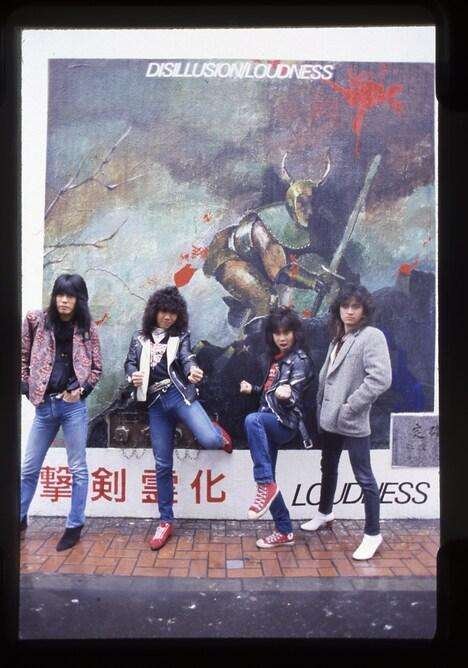
We should also stop here for a moment and talk about Minoru Niihara, because his development is fundamental to understanding what would happen later. Singing in English was not simply a matter of replacing one set of words with another. The vocalist himself has explained that at first he was not a professional singer and had to adapt quickly to the demands of the band, while the transition from Japanese to English represented another completely different challenge.
The English version of Disillusion is therefore much more than a reissue. It is the first test of Loudness beginning to change in order to enter the Western market. And here we encounter one of the most interesting contradictions of their entire career: in order for the world to listen to Loudness, Loudness had to learn to speak a language that was not their own. Fortunately, they had not yet lost their personality.
Thunder in the East
And then came Thunder in the East. Pals, this is where we are already talking about a different league. Released in 1985 and produced by Max Norman, the album was recorded at Sound City in Los Angeles and became the real international breakthrough for Loudness. Atlantic Records handled its American release and the album eventually reached No. 74 on the Billboard 200, remaining on the chart for more than twenty weeks according to various sources. The band’s own official history regards that release as one of the great milestones of their career and particularly notes that it was the first Japanese heavy metal album to achieve such an impact in the United States. (loudnessjp.com)
The context was simply perfect and terrifying at the same time. Los Angeles had become one of the world’s great centres of hard rock and metal, MTV was beginning to wield enormous influence and bands such as Mötley Crüe, Ratt, Dokken, Quiet Riot and Twisted Sister were proving that heavy metal could become a mass-market phenomenon. Loudness entered that jungle from Osaka with one obvious advantage: technically, they could compete with anyone.
Crazy Nights was the song that opened the door. Its riff is immediate, the chorus is designed to be sung by thousands of people and Niihara launches into English with a mixture of determination and personality that would eventually become an inseparable part of the band’s sound. The video received MTV rotation and the song became the great introduction to a band that, until very recently, had been singing in Japanese.
But reducing Thunder in the East to Crazy Nights would be a real injustice. Like Hell, Heavy Chains, Get Away and Clockwork Toy demonstrate that the band had not abandoned their more aggressive side. What they had done was wrap it in a much bigger and more accessible production. Takasaki was still the same guitarist capable of firing off blisteringly fast solos, Higuchi remained a beast behind the drums and Yamashita maintained the weight needed to prevent the songs from becoming a guitar showcase with accompaniment. What had changed was the context.
Now Loudness had an American record company, an American producer, songs in English and a huge market waiting for the next big name. The band’s official history states that the success of their first international tours was precisely what attracted Atlantic and led to the worldwide contract. The operation had worked and that was precisely where the problems began.
Shadows of War
Because getting into the United States is one thing; convincing the United States that you are there to stay is something completely different. Shadows of War, released in Japan in 1986, was the logical next step after Thunder in the East, but it also began to reveal the tensions developing between the band’s identity and the expectations of the American market. For its US release, the album was remixed and renamed Lightning Strikes, and that difference between the two editions is quite revealing.
The album still contained great songs and Takasaki was still playing as though speed were a personal matter, but the sound was beginning to move towards more accessible territory. Let It Go is probably the clearest example of that transformation and also a perfect illustration of the direction the industry wanted to explore. Loudness had demonstrated that they could sell records in the United States and now the machinery wanted to know how far it could take them.
They were not the only ones facing that pressure. At that time, virtually every heavy-metal band aspiring to succeed in America was subject to the same logic. Image, videos, choruses, production and accessibility were becoming increasingly important. Scorpions had learned to play that game, Judas Priest had been doing it in their own way for years and the new American bands were turning the genre into an enormous spectacle. Loudness had to decide how much they were willing to give up.
Lightning Strikes reached No. 64 on the Billboard 200, even improving upon the position of Thunder in the East. On paper, that was a success. But history is rarely as simple as a position on a chart. While American audiences responded to this new version of Loudness, part of their Japanese audience was beginning to look at the band’s progressive adaptation to the Western market with some distance. And here we encounter a question that I think is fundamental to understanding this entire period: what does it really mean to internationalise a band? Because taking your music to another country is one thing, and changing it so that it fits in there is something else entirely.
Lightning Strikes
The American version of Shadows of War is, in reality, a document of an era in which musical borders were disappearing while, at the same time, record industries were trying to establish new ones. Loudness could play wherever they wanted, but the market had a fairly specific idea of what it wanted to hear.
The result is not a bad album, far from it. It would be absurd to deny the quality of musicians such as Takasaki, Higuchi, Yamashita and Niihara, and besides, songs such as Crazy Nights had already proved that they could build genuine anthems. But the context makes it more interesting than a simple discussion of musical quality. The album is the sound of Loudness discovering that success itself can become a trap.

The comparison with Van Halen or Mötley Crüe was not exactly insignificant either. Those bands had enormous machinery behind them and a musical culture completely integrated into the American market. Loudness had to convince an audience that could still perceive them as an exotic curiosity.
Perhaps that is why Takasaki is so important. If the band had lost its instrumental personality, all of this might have been reduced to a failed attempt to manufacture a Japanese version of American glam metal. But the guitarist was simply too good and too distinctive to disappear behind the production. His playing remained recognisable and, at times, even seemed to be fighting against the very limitations the new context wanted to impose.
There is something almost tragic about that struggle. Loudness had crossed half the world to prove that they could play by the same rules as the great Western bands and, once inside the game, discovered that those rules could constantly be changed.
Hurricane Eyes
With Hurricane Eyes, released in 1987, we reach the point where this first chapter begins to take on a different tone. Loudness were still an extraordinarily competent band and the album contains material of tremendous quality, but it is now impossible to listen to it without keeping in mind the international machinery that had been set in motion around the group. Production was handled by Eddie Kramer, a genuine institution whose résumé included work with Jimi Hendrix, Led Zeppelin, Kiss and The Rolling Stones, while Andy Johns worked on So Lonely, a new version of Ares Lament from Disillusion.
The names of those producers alone tell part of the story. Loudness had gone from recording their first albums in Japan to working with some of the professionals who had helped build the history of Western rock. That could be any musician’s dream, but it could also become a trap. The bigger the stage, the greater the pressure for the band to behave as people expected them to.
Hurricane Eyes is still very much Loudness. Takasaki has not lost his ability to turn the guitar into a spectacle, Higuchi and Yamashita remain a formidable foundation and Niihara retains that voice which was already inseparable from the band’s identity. But the balance is different. The production is more sophisticated and the group is much closer to the hard-rock and pop-metal codes dominating the American market.
And yet there is a wonderful irony in the fact that the Japanese version of the album brought back much of the material with Niihara singing in Japanese. The band were literally offering two versions of themselves. One for the West and another for Japan. One trying to be understood by the international market and another remembering where it had come from.
The American commercial result was considerably weaker than that of the two previous albums. Hurricane Eyes only reached No. 190 on the Billboard 200 and spent four weeks on the chart. In Japan, however, the Japanese-language version reached No. 34. The storm was beginning to clear.
Jealousy
And then we arrive at Jealousy, the 1988 EP that would precede one of the most important changes in the entire career of Loudness. It is important not to jump directly to Soldier of Fortune, because doing so would mean erasing precisely the moment when the classic lineup ceased to exist.
Minoru Niihara was removed from the band and replaced by the American Mike Vescera, formerly of Obsession. The decision was connected to the idea that an English-speaking vocalist might make it easier for Loudness to gain access to the American market.
It is difficult not to find the situation paradoxical. For years, Niihara had been one of the voices defining the band’s sound. He had started out singing in Japanese, learned to sing in English, crossed the ocean and provided the voice for Crazy Nights. He had stood alongside Takasaki, Higuchi and Yamashita from the very beginning. And now, precisely when the band were trying to consolidate their position in the United States, that same process of internationalisation became the argument for getting rid of him.
This is where, for me, the first great Loudness movie ends, not because there is nothing interesting to say about what came next, but because the departure of Niihara is not merely another lineup change. It is the moment when the story that began with The Birthday Eve reaches its natural conclusion.
Up to this point we can follow a fairly clear line. Four musicians from Osaka discover heavy metal, form a band, release four increasingly impressive albums, leave Japan, travel to Europe, reach London, record in Los Angeles, sign with Atlantic, enter the Billboard 200 and achieve something that no other Japanese metal band had accomplished before them on anything like the same scale. And they do it without Takasaki, Higuchi, Yamashita and Niihara ceasing to be recognisable.
But international success has a price. And in 1988 that price is called Minoru Niihara. Let’s not fool ourselves, pals, the story of Loudness does not end here, not by a long shot. In fact, what comes next will probably be one of the most interesting and controversial periods of their entire career, because the arrival of Mike Vescera will lead to Soldier of Fortune and On the Prowl, while the band tries desperately to keep open an American door that is becoming increasingly difficult to walk through. But that belongs to another story. For now, I would rather stop here, precisely at that moment when we can still look back and contemplate the road travelled.
From The Birthday Eve to Hurricane Eyes, Loudness went from being four Japanese musicians in love with Western heavy metal to becoming a band capable of sharing space with the biggest names in the genre. They proved that Japan did not have to limit itself to importing heavy metal: it could produce it, develop it and export it. Akira Takasaki had become one of the great guitarists of his generation, Munetaka Higuchi and Masayoshi Yamashita had built one of the strongest rhythm sections in Japanese metal and Minoru Niihara had managed to make a voice born in Osaka eventually sound on radio stations and stages around the world.
And perhaps that is the real greatness of this first period. Not that Thunder in the East reached the Billboard 200, nor that Crazy Nights became their anthem, nor even that Loudness achieved something that had seemed impossible only a few years earlier. What is truly extraordinary is that when we listen to those early albums in sequence, we can follow the journey perfectly. We can hear four musicians discovering the genre, beginning to master it, daring to leave their country, reaching Europe, crossing the Atlantic and finally confronting an industry that wanted to turn them into something different.
The story of Loudness between 1981 and 1988 is, at heart, a story about identity. About what happens when a band stops playing only for the people who know them and begins playing for a world that wants to decide who they should be. And if there is one thing that fascinates me about those seven years, it is that, even when circumstances began pushing them in another direction, we can still find those four original musicians in those records, the ones who first stepped onto a stage with the ambition of proving that heavy metal knew no borders. They came from Osaka, They crossed the whole world… They made it to America! And now they had to discover what remained of Loudness when the storm was over. Only time will tell.