Mastodon: Marrow Deep (2026, Loma Vista Recordings)
Mastodon look back to their most celebrated era on «Marrow Deep», recovering the heaviness and progressive spirit of «Leviathan» and «Crack the Skye» while refusing to completely abandon the mature sound developed during the last decade.
There are bands whose evolution can be followed almost like a map. You can draw a line between their records, identify the moments where they changed direction and, with enough distance, understand how one album inevitably led to the next. Mastodon have always been a little more complicated than that. Their career has been built around constant movement, but that movement has never been entirely linear. They have gone from the crushing sludge of Remission to the enormous progressive landscapes of Leviathan and Blood Mountain, from the conceptual complexity of Crack the Skye to the increasingly direct approach of The Hunter and Once More ’Round the Sun, before entering a more mature and introspective period with Emperor of Sand and Hushed and Grim. Five years after the latter, Marrow Deep arrives in a very different world, and perhaps the most interesting thing about it is that it does not really know whether it wants to move forward or look back.
The circumstances surrounding the album make that uncertainty even more understandable. Marrow Deep is the first Mastodon record without Brent Hinds, whose departure from the band in 2025 was followed only months later by his tragic death in a motorcycle accident. At the same time, Brann Dailor was dealing with the loss of his mother, and grief had already been an important part of the band’s creative process throughout their career. It would therefore be very easy to approach this album exclusively through the prism of loss, but that would ultimately do it a disservice. Mastodon have always transformed difficult experiences into music rather than simply documenting them, and Marrow Deep is much more interesting when considered as the first attempt by this new incarnation of the band to discover what remains when one of its most unpredictable elements is no longer there.
The answer, at least during the opening stages, is surprisingly encouraging. Barbarians Blood begins with a ferocious drum pattern before the guitars crash in with one of those riffs that immediately makes you think of the Mastodon of fifteen or twenty years ago. It is heavy, intricate and full of movement, but what really catches the attention is the feeling of urgency. There is much more physicality here than on large portions of Hushed and Grim, and the impression that the band are genuinely enjoying playing these songs is difficult to ignore. Poisonous Weapons follows with a slower and heavier attack, driven by Troy Sanders’ bass and vocals, while Your Ghost Again takes the formula into more melodic territory without abandoning that old sense of danger. The latter in particular feels like a missing link between the Mastodon of Blood Mountain and the band they have become today, combining a twisting sludge riff with synthesised textures and a surprisingly immediate chorus.
And this is where that sensation of a half-return to the past begins to make sense. Marrow Deep does not attempt to recreate Leviathan, but it remembers how Mastodon used to write when the riff was the centre of gravity rather than simply one element within a much larger arrangement. There is a certain physicality to the guitars that had become less prominent during the band’s most recent period, and Brann Dailor’s drumming is once again allowed to occupy considerably more space. His fills are busier, stranger and more instinctive, recalling the musician who seemed capable of turning almost any Mastodon song into a miniature lesson in progressive drumming. Golden Spires is probably the clearest example, and if anyone needed reminding of why Dailor became such an important part of the band’s identity, this song provides the evidence.
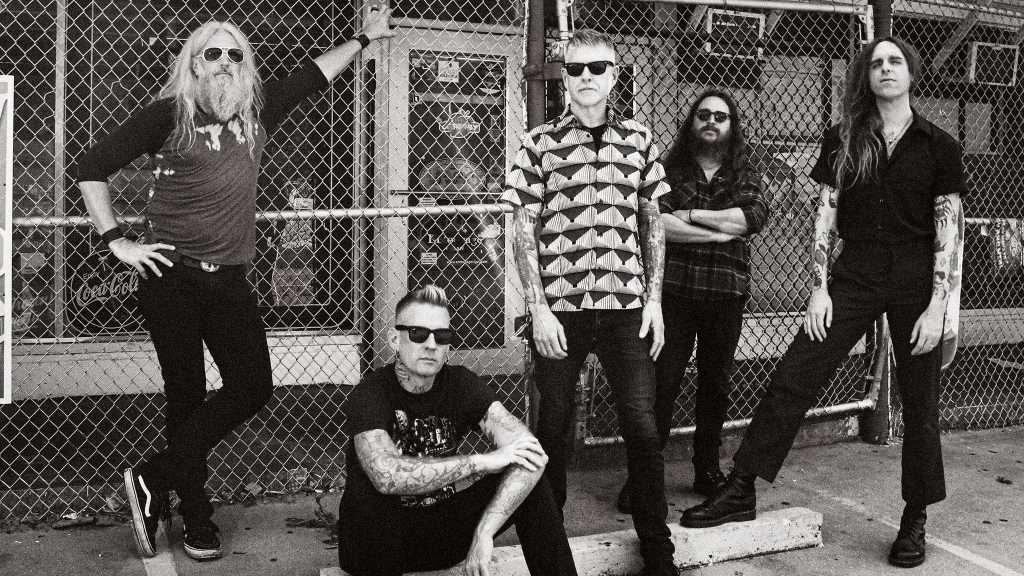
There is also a new ingredient in the equation. Guitarist Nick Johnston and keyboardist João Nogueira make their recorded debuts with the band, and rather than simply trying to fill the empty spaces left behind, both bring elements of their own personalities into the compositions. Nogueira’s keyboards appear throughout the album, sometimes subtly and sometimes much more prominently, creating a melodic counterpoint to Bill Kelliher and Johnston’s guitars. This is particularly effective because Mastodon have never been afraid of introducing apparently incompatible elements into their music, and the keyboards give some of these compositions the psychedelic quality that made Crack the Skye so fascinating. Johnston, meanwhile, brings a more refined and technically polished approach to the guitar, which creates an interesting contrast with Kelliher’s heavier and more muscular style.
It would nevertheless be dishonest to pretend that this is simply the album that fans of Leviathan have been waiting for. It isn’t. In fact, one of the most revealing aspects of Marrow Deep is the way it keeps alternating between moments where the old Mastodon seem to be returning and others where the band sound completely comfortable with the direction they have taken during the last decade. Snakes for Dinner, featuring Josh Homme, is a good example of the latter. Its swaggering character has little to do with the brutal urgency of Remission, but it fits naturally within the broader history of a band that has always been fascinated by psychedelic rock, Southern rock and alternative music. Homme’s presence also creates an amusing connection with Blood Mountain, where he contributed vocals to Colony of Birchmen, reinforcing the sensation that Marrow Deep is constantly looking backwards while attempting to move forward.
The same could be said of Out Like a Lamb and They’re Coming for You, two songs that reinforce the album’s variety but do not necessarily contribute equally to its identity. This is one of the main strengths and weaknesses of Marrow Deep: there is considerably more diversity here than one might expect from a record supposedly returning to the band’s roots, but not every experiment produces the same results. Mastodon have always been capable of moving from crushing riffs to melodic passages without losing their personality, yet there are moments here where the transitions feel somewhat calculated, as though the band have discovered that every heavy section needs to be balanced by something softer and more atmospheric. When that balance works, the contrast is fantastic; when it doesn’t, the songs simply seem to lose momentum.
This is particularly noticeable in In the Ruins and Moth and Bone, where the slower passages sometimes feel less like necessary breathing spaces and more like interruptions to otherwise interesting compositions. The problem is not that Mastodon have become too progressive or too atmospheric. Nobody should expect this band to return permanently to 2004. The problem is that some of these quieter sections do not possess the same personality as the heavier material surrounding them. The contrast between brutality and beauty has always been fundamental to Mastodon’s music, but during their best period the two elements were often inseparable; the beautiful melody was already hidden inside the riff, and the strange progressive passage somehow made the main riff sound heavier when it returned. On Marrow Deep, the relationship is occasionally more obvious and therefore less effective. And that brings us back to Brent Hinds.
His absence is impossible to ignore precisely because his contribution to Mastodon was never merely technical. Hinds brought an unpredictable quality to the band, both as a guitarist and as a songwriter, and that unpredictability could be one of their greatest strengths or one of their most obvious weaknesses. There were moments when his playing seemed to come from somewhere completely outside the boundaries of the song, creating that wonderful sensation that Mastodon might collapse under the weight of their own ideas before somehow landing perfectly on their feet. There were also moments when that same instability threatened to drag the band in the opposite direction. Marrow Deep is a more controlled record, and that control is often welcome, but it comes with a price. The ceiling may be slightly lower without Hinds’ wildest ideas, even if the floor is considerably more stable.
That is why comparing Marrow Deep with Emperor of Sand is particularly interesting. The latter was already a much more mature and streamlined version of Mastodon, an album where the band’s progressive tendencies had been incorporated into songs that were generally more direct and accessible. Once More ’Round the Sun went even further in that direction, embracing hooks and structures that would have been almost unthinkable during the band’s early years. Hushed and Grim, meanwhile, expanded everything into a huge double album whose ambition sometimes exceeded its ability to maintain momentum. Marrow Deep seems to react against that tendency. It is more compact, more aggressive and considerably more interested in the riff, even when it occasionally falls back into the same atmospheric habits.
Perhaps that is why the album feels so varied without ever becoming completely schizophrenic. There are moments that sound like Crack the Skye, others that recall Blood Mountain, some passages that could comfortably have appeared on Emperor of Sand, and even a few that seem to be pointing towards something the band have not quite defined yet. The Vanishing, with Geezer Butler contributing the extended bass introduction, is perhaps the most obvious example of this willingness to experiment. The connection with Black Sabbath is hardly subtle, but it does not need to be. Mastodon have spent their entire career carrying Sabbath’s influence somewhere inside their DNA, and having Geezer himself appear on the album turns that influence into something almost tangible.
The final stretch becomes even more interesting with A Vampire’s Demeanor and The Three Fates. The former brings together a more aggressive Mastodon with additional vocal contributions, while the latter closes the record with Neil Fallon and returns to the band’s more expansive side. It is an appropriate ending because The Three Fates feels less concerned with proving that Mastodon can still sound heavy and more interested in demonstrating that there are still unexplored corners within their sound. It does not provide a neat conclusion to the album, and perhaps that is exactly what makes sense. Marrow Deep is not a statement of arrival but a record about recalibration.
That word may ultimately be the best way to describe it. Mastodon are recalibrating.
They are dealing with the absence of one of the people who helped define their sound for more than two decades, introducing two new musicians into the creative equation and simultaneously rediscovering some of the instincts that made their early records so special. The result is neither a nostalgic exercise nor a radical reinvention. It is something much more human: a band trying to remember what it was capable of while accepting that it can never become the same band again.
And perhaps that explains why Marrow Deep works best when it stops trying to prove anything. The strongest songs are the ones where the four musicians simply sound hungry again, where the riffs have weight and the drums are allowed to run wild, where the melodies emerge naturally rather than being inserted to create a predictable contrast. Barbarians Blood, Poisonous Weapons, Your Ghost Again and Golden Spires are the clearest examples, and together they form the heart of the album. They do not sound like leftovers from the band’s past; they sound like reminders of what made that past so powerful in the first place.
There are still flaws, and they become more noticeable precisely because the good moments are so good. Some of the quieter sections drag, some of the longer compositions could have benefited from stronger editing and there are occasions when the album seems to confuse atmosphere with depth. Mastodon have never needed to make every song enormous in order to sound ambitious, and Marrow Deep occasionally forgets that lesson. The record is also unlikely to satisfy listeners expecting a second Leviathan or Crack the Skye, because that album simply cannot exist anymore. Too much has changed, both inside and outside the band.
But perhaps that is the point. I don’t think Marrow Deep is a return to the golden age of Mastodon. I don’t even think it tries to be one. What it does is much more interesting: it retrieves pieces of that era and places them inside the band they have become. The aggression of Leviathan, the progressive instincts of Crack the Skye, the melodic accessibility of Emperor of Sand and the introspection of Hushed and Grim are all somewhere in here, although not always in equal proportions. The result is uneven at times, but also considerably more alive than a simple exercise in nostalgia would have been. After twenty-five years, Mastodon no longer have anything to prove. What they do have is a legacy large enough to become a burden if they allow it to. Marrow Deep is at its best when they ignore that burden and simply play. When Dailor’s drums start running, when Sanders’ bass begins to rumble and Kelliher and Johnston find the riff, the past suddenly stops being a comparison and becomes part of the present. Maybe that is what a band like Mastodon needs after everything that has happened. Not to go back. Not to replace what was lost. Just to keep moving. And if Marrow Deep is any indication, there is still plenty of life left in the beast.