The Night Eternal: Cold Velvet (2026, Metal Blade Records)
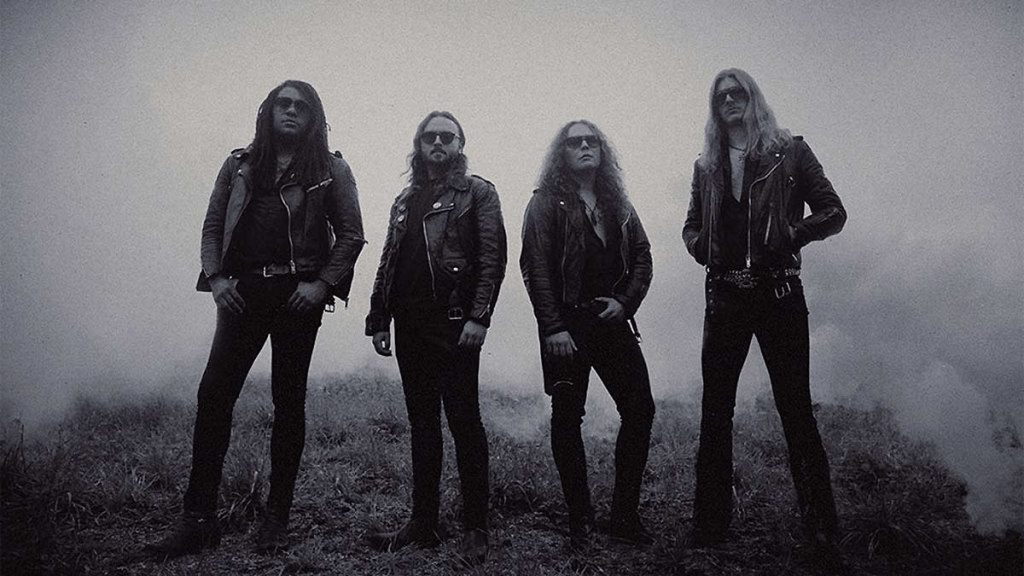
Nostalgia is a strange thing. Sometimes it comes from something as simple as listening to a song that takes us back to a particular moment in our lives, but there are other kinds of nostalgia that are much harder to explain. The nostalgia for something we never experienced, for places we have never visited or for a time that perhaps never existed. It is a feeling that has always been present in the music of The Night Eternal, but on Cold Velvet it becomes almost tangible, turning the band’s third full-length into an album that feels less like a collection of songs and more like a journey through a world that exists somewhere between memory and dream.
The German band have been building this particular universe since Moonlit Cross, combining the foundations of traditional heavy metal with gothic rock, dark melodies and an increasingly strong sense of atmosphere. Fatale represented an important step forward, refining their sound and demonstrating that The Night Eternal were capable of looking towards the past without simply becoming another retro act. With Cold Velvet, however, the emphasis has shifted. The guitars are still there, the riffs are still unmistakably rooted in heavy metal and Ricardo Baum‘s voice remains one of their most distinctive characteristics, but everything seems to have been given more room to breathe. There is more space, more melancholy and, above all, a strange feeling of distance. It is almost as if The Night Eternal have stopped looking backwards and started looking somewhere else.
The opening trio of Where This World Ends, Eurydice (Don’t Look Back) and Caught In A Spell immediately establishes this new atmosphere. There are plenty of melodies capable of getting stuck in your head, but the first thing that catches the attention is not the hook or even the riff: it is the sensation surrounding them. The guitars seem to emerge from a fog, while Baum‘s vocals are given enough space to sound simultaneously intimate and distant. Eurydice is perhaps the most immediate of the three, with a magnificent chorus and a strong traditional heavy metal backbone, whereas Caught In A Spell takes the band further into gothic territory, adopting a more relaxed rhythm and an almost hypnotic quality.
It is difficult not to associate some of these images with Edgar Allan Poe. There is a similar fascination with beauty surrounded by decay, with something attractive that nevertheless makes you feel uncomfortable. At the same time, there is an almost Lovecraftian quality to the album’s atmosphere, although not necessarily in the sense of monsters, tentacles and cosmic horror. What The Night Eternal capture is that much more unsettling feeling that there might be something beyond what we can see, something ancient and unknowable lurking behind the landscape.
And that is one of the reasons why the title Cold Velvet works so well. Velvet is soft, warm and pleasant to the touch, while the word «cold» immediately contradicts that sensation. The music works in exactly the same way. There is warmth in the production, richness in the guitars and plenty of beautiful melodies, yet there is always something distant and cold hiding beneath them.
When The Last Candle Dies reinforces this idea rather than trying to break it. The song is not particularly fast or aggressive, but it possesses an enormous amount of character, and the melodies are allowed to develop naturally instead of being forced into a succession of obvious climaxes. Together with the songs that surround it, it gives the first half of the album a remarkably consistent personality. This is not music that demands your attention by force; it gradually creates an environment and invites you to remain inside it. That approach will probably be one of the things that divides listeners.
Anyone coming to Cold Velvet expecting Fatale with a different cover may find that the album takes its time. There are moments when you can almost feel the band deliberately holding themselves back, especially when the guitars suggest that there is considerably more power available than they are actually using. The riffs are good enough to support a much more aggressive record, but The Night Eternal seem more interested in what happens when they allow those riffs to coexist with silence, atmosphere and melancholy. Personally, I think that decision is what gives Cold Velvet its identity.
There is something strangely cinematic about it. Not in the sense that the band are writing film soundtracks, but because many of these songs seem to create places rather than simply accompany a melody. Listening to Cold Velvet sometimes feels like walking through an abandoned landscape where nothing is happening and yet you cannot shake the sensation that something is about to happen. It is an atmosphere that immediately brings to mind Andrei Tarkovsky’s Stalker, where the landscape itself becomes part of the story and a seemingly empty room can possess more tension than an entire action sequence.
The Night Eternal understand that principle remarkably well. Their music does not need to be constantly changing in order to remain interesting because the texture itself is changing. A guitar melody appears in the distance, Baum’s voice moves through it, the rhythm section establishes a slow pulse and suddenly the song seems to occupy a much larger space than it did a few seconds earlier.
The second half of Cold Velvet takes some of that accumulated atmosphere and gives it more muscle. The Veins Of Time is a good example of this transition, bringing back some of the urgency that listeners might have been missing during the more restrained passages. It is followed by The Watcher Of The Burning Veil, where the band finally let the heavy metal side of their personality take centre stage. The guitars become heavier, the rhythm more forceful and the chorus has precisely the kind of grandeur that should work wonderfully in a concert hall.
The contrast is important because it prevents the album from becoming a completely uniform exercise in melancholy. The Night Eternal know when to accelerate and, perhaps more importantly, they know when not to. Shape Of Sorrow continues along this more energetic path while retaining the melodic character that defines the album, and together these songs demonstrate that the band have not abandoned the more direct approach that made Fatale so effective. They have simply placed it inside a larger and darker framework.
There is also something particularly visual about these songs. The riffs seem to suggest movement, almost as if the listener were travelling through some immense landscape, and that brings another cinematic reference to mind: Andrzej Żuławski‘s On the Silver Globe. It is one of those films where the sensation of being somewhere completely alien is more important than understanding exactly what that place is. Its landscapes are beautiful, strange and frequently hostile, and there is an almost dreamlike feeling of a civilisation trying to understand itself after being separated from everything familiar.
That is remarkably close to the feeling I get from Cold Velvet. Not because The Night Eternal sound like the soundtrack to On the Silver Globe, but because both works seem fascinated by the same contradiction: the attraction of the unknown and the fear that comes with it. There is beauty in the darkness, but the darkness never stops being dangerous.
By the time Dance On Crimson Ground arrives, the album has already established its world, which makes the decision to finish with its longest composition feel completely natural. Rather than trying to end with another big chorus or an explosive final riff, the song takes its time. The melodies unfold gradually and the atmosphere becomes increasingly expansive, almost as if the listener were finally reaching the end of the journey.
It is the perfect conclusion precisely because it does not feel like a conventional conclusion. The world created during the previous seven songs does not suddenly disappear. Instead, it slowly fades into the distance, and perhaps that is what The Night Eternal have achieved with Cold Velvet more successfully than anything they have recorded before. They have created an album that feels remarkably cohesive without necessarily relying on every song sounding the same. The recurring ingredients are obvious — traditional heavy metal, gothic rock, melancholic melodies, Ricardo Baum’s voice and an unmistakable eighties influence — but the way they are combined creates a mood that belongs entirely to the band. Of course, this comes with a price.
Cold Velvet is not as immediate as Fatale, and I suspect some listeners will find its deliberately restrained approach frustrating. There are songs that could have benefited from another burst of aggression, and the consistency of the album’s melancholic atmosphere means that those looking for constant changes of pace may find the second half somewhat predictable. It is also an album that requires patience. Some of its melodies only reveal their full potential after several listens, rather than grabbing you immediately.
But perhaps expecting Cold Velvet to behave like a conventional heavy metal album misses the point. This is an album about atmosphere first and riffs second. The riffs are good, sometimes excellent, but they are there to construct something larger. The songs are windows into the same world, and the album works best when listened to as a whole rather than as a collection of individual tracks.
That is why I keep coming back to the idea of nostalgia. There is nothing specifically nostalgic about Cold Velvet in the sense of remembering a particular childhood, decade or musical era. Instead, it evokes nostalgia for something imaginary. It sounds like memories of places that never existed, like fragments of a film you watched in a dream and cannot quite remember when you woke up. It is the sensation of seeing a ruined city at dusk and somehow knowing that you have been there before, despite being absolutely certain that you have not.
Poe and Lovecraft could have understood that feeling. Tarkovsky and Żuławski turned it into images. The Night Eternal turn it into music. And that is ultimately why Cold Velvet works so well.
It is not the band’s most aggressive album, nor their most immediately accessible. It is something considerably more difficult to achieve: a record with its own atmosphere, its own visual language and its own sense of place. The band have taken the foundations they established on their previous albums and pushed them towards something colder, more spacious and more cinematic without losing the heavy metal heart underneath.
When the final notes of Dance On Crimson Ground disappear, the feeling is not so much that an album has finished as that a door has closed somewhere in the distance. You are back where you started. But for forty minutes, you were somewhere else, and sometimes that is exactly what music is supposed to do.